Your miner stopped being profitable, now what?
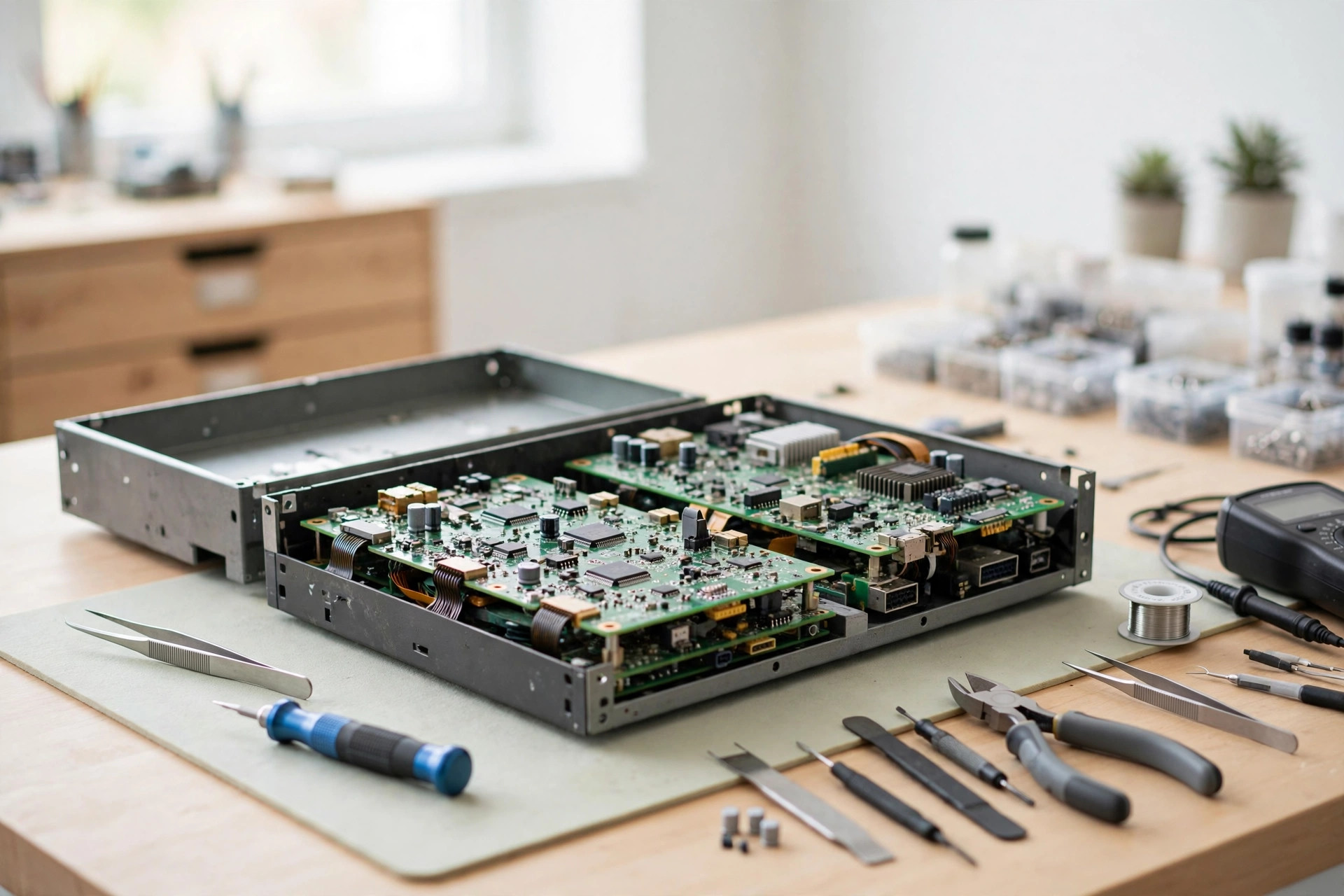
Every miner dies twice: first economically, when difficulty and power costs push it underwater; then physically, when a board or PSU gives up. A dead unit sitting in a closet is dead capital, it earns nothing while whatever value it has left evaporates. The decision is repair, sell whole, part out, or recycle, and there's a defensible order to try them in. Prices below are May 2026 secondary-market figures, clearly dated, verify current values before acting on them.
First: why it's dead, and whether it could come back
Diagnose before deciding. The common failure modes are hash board failure (reduced hashrate, board errors in the dashboard), control board failure (no network connection, blank interface), PSU failure (won't power on, random shutoffs), fan failure ($15 to $40 per fan, but ignored dead fans cascade into board damage), and thermal damage from running hot. Also ask the economic question separately: even repaired, would this unit earn anything at your electricity rate? Repairing a miner that was already underwater is just spending money to lose money more reliably.
The decision tree: repair, sell whole, part out, recycle
Work this in order:
1. Check warranty first. Bitmain covers new units for 180 days; MicroBT (Whatsminer) covers 365 days. If you're inside the window, use the manufacturer RMA, don't attempt DIY repair first, it voids the warranty. Expect 4 to 8 weeks of turnaround, which is lost mining income to factor in.
2. Price the repair against the 40/60 rule. If total repair cost exceeds 40% of the miner's current working market value, the economics get marginal. Past 60%, you're better off selling broken or parting out. Third-party repair shops charge roughly $100 to $300 per hash board for diagnostics and chip-level repair. As a reference, May 2026 working values ran about $400 to $600 for an Antminer S19j Pro and $1,500 to $2,200 for an S21/S21 Pro, so a $250 board replacement on an S19j Pro lands at 42 to 63% of its working value, at or past the 60% line. The answer is usually "don't."
3. If repair fails the math, sell it broken, whole. A broken miner still has value: typically 40 to 65% of its working price for a single-board failure on a popular model, 25 to 45% for multi-board or control-board failures. There's a real secondary market of repair shops, hobbyists, and data centers buying broken units.
4. Part it out when the whole is worth less than the pieces. Working hash boards have strong standalone demand. S19j Pro boards at $150 to $250, S21 boards at $400 to $600. Working PSUs fetch $80 to $150, control boards $80 to $200, fans $15 to $40 each. Parting out beats selling whole for older models with weak whole-unit demand, or when multiple boards are dead but the PSU and fans are fine. It takes more time and more listings.
5. Recycle what's left. When nothing has resale value, electronics recyclers buy dead units and components. ASIC miners, hash boards, PSUs, fans, racks, networking gear. It's the floor, not the plan: recover what's recoverable first.
Where to sell, compared honestly
| Channel | Typical recovery | Speed | Best for |
|---|---|---|---|
| Hardware resellers / dealers | 60 to 75% of market value | Days | Confirmed-working units; fastest exit |
| eBay | Varies; buyer protection both ways | 1 to 2 weeks | Maximum visibility; broken units sell regularly |
| Mining forums (Bitcointalk, Reddit) | 75 to 85% of market value | Weeks | Knowledgeable buyers, lower fees, needs credibility |
| Telegram trading groups | Varies | Days | Active traders who know exact values; higher scam risk |
| Local listings | Varies | Days | Heavy units, avoids shipping costs |
Recovery percentages are reported market patterns, not guarantees. Documenting the miner's actual hashrate and error log before listing consistently produces better outcomes, buyers pay a premium for a verifiable operational record over an unverified unit of unknown condition.
Listing it so buyers trust it
Disclose the specific fault: which board failed, what the dashboard shows, whether you attempted repair. Accurate, detailed listings attract serious buyers and prevent disputes; vague "for parts or not working" listings get lower bids. Include photos of any overheating marks or dust buildup, confirm serial numbers match (non-matching serials are a counterfeit red flag for buyers), and state the unit's history, hours run, parts replaced, operating environment. What you'd want to know as a buyer is exactly what to write as a seller.
Don't get scammed on the way out
Selling is still a transaction with a stranger. Protect yourself the boring way: use platforms with seller protection, never accept overpayment-and-refund arrangements, don't ship until payment has fully cleared (not "pending"), and meet local buyers in daylight with the unit powered on and demonstrable. A buyer in a hurry is a buyer to slow down.
FAQ
Should I repair a miner that's still under warranty? No, use the RMA. DIY repair voids it. Bitmain's 180 days and MicroBT's 365 days are real coverage; use it.
Is it ever worth repairing an old S19? Only for cheap failures: a PSU at $80 to $150 or a fan at $15 to $40 is almost always worth it. A hash board at $150 to $250 on a $400 to $600 unit is at or past the 60% line, sell it broken or part it out instead.
What if the miner works fine but just isn't profitable? Then it's an economic death, not a physical one. Sell it whole while it still has resale value, a working unit on a dealer or forum listing beats a dead one in a closet every time. And re-run the numbers before replacing it: the replacement has to earn more than the repair-plus-power math you're escaping.