Home mining's noise and heat: what it's actually like to live with a miner
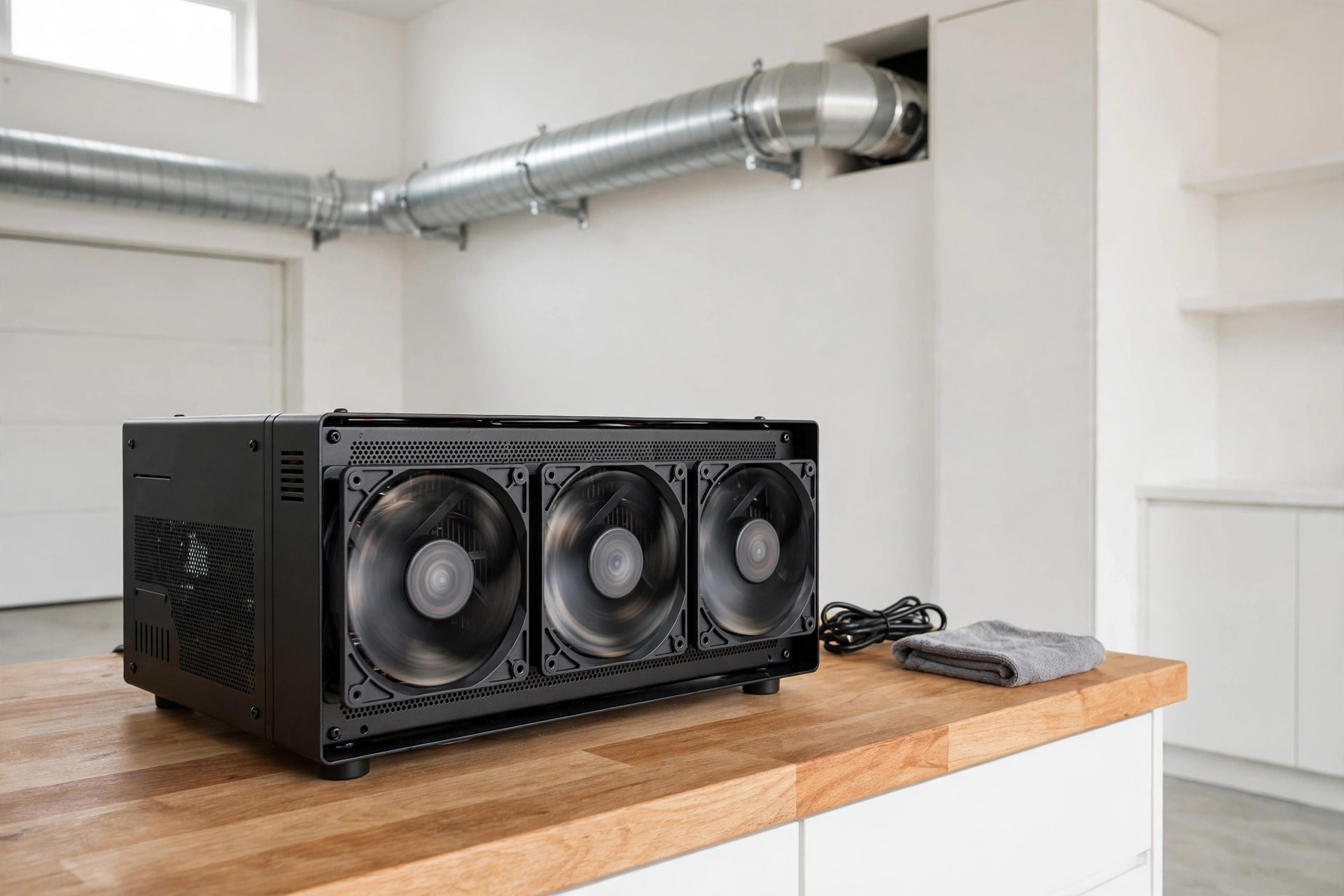
Most mining guides lead with hashrate and electricity prices. But the thing that actually ends home-mining experiments is rarely the math, it's the machine. A full-size air-cooled ASIC runs twenty-four hours a day at roughly vacuum-cleaner volume, throwing off space-heater heat around the clock. That's an appliance you share your home with, and it changes the question from "is this profitable?" to "can I live next to this?"
What the numbers actually sound like
Published specs are consistent. Independent spec listings rate the Antminer S21 at 75 dB, and the newer S21 XP (270 TH/s, 3645W) carries the same 75 dB, new generations did not get quieter. Air-cooled ASICs generally run 70 to 80 dB continuously, some reaching 75 to 83 dB. For scale: anything above about 55 dB is intrusive in a home, and most residential noise ordinances cap nighttime outdoor noise at 45 to 55 dB. One reseller calls 75 dB "a tolerable noise level." That's marketing. A vacuum cleaner that never turns off is the honest description.
The three living-with-it problems
Noise. It's continuous. Fans run full speed around the clock, and there's no quiet mode that preserves performance, a silenced miner is a miner earning nothing.
Heat. A 3.5 kW ASIC produces over 12,000 BTU/hr, roughly three space heaters in one spot. Without active exhaust the room overheats, and heat isn't just uncomfortable: ambient temperatures above about 30°C can throttle hashrate ~15% or trigger shutdowns.
Air and dust. Those fans move serious air, which means dust. Clogged heatsinks lose efficiency, fan failures under 24/7 load are common ($50 to $200 per fan), and a realistic annual maintenance budget is $500 to $2,000.
The mitigation ladder: what actually helps, in order
1. Placement. A detached garage, shed, or ventilated basement is the cheapest real fix. Home miners who made it work nearly always moved the machine out of living space, one described ASICs as "jet engines" that vibrated the floor until the unit went to the garage.
2. Sound-dampening enclosures. Insulated boxes shave off a few decibels but trap heat, the other problem. Any enclosure needs engineered airflow.
3. Water-cooled (hydro) models. These drop noise to roughly 38 to 58 dB, genuinely livable, but add plumbing complexity and cost. A real option, not a magic one.
4. Use the heat. The one case where home mining's physics work for you: thermal recovery. In winter, waste heat replaces heating you'd pay for anyway.
The honest ceiling: nothing here makes a 75 dB air-cooled ASIC bedroom-compatible. Mitigation buys livability at a distance, not silence.
The "can you even run one here" checklist
1. The noise test. Could your household tolerate a vacuum cleaner running 24/7 in that room? Could neighbors hear it at night, given 45 to 55 dB local caps?
2. The electrical test. One miner needs a dedicated 15 to 20A circuit at 220 to 240V. Does your panel have capacity? That's an electrician question, not a guess.
3. The permission test. Renters: does the lease allow a 3.5 kW appliance running continuously? HOAs: check noise and home-business rules.
4. The exhaust test. You must move 12,000+ BTU/hr out of the space continuously. "Leave the door open" is not a plan.
5. The rate test. Residential rates of $0.15 to $0.30/kWh are common, and mining turns marginal above roughly $0.08 to $0.12/kWh for most hardware.
6. The maintenance test. Budget $500 to $2,000 a year. A home miner is a small industrial appliance and fails like one.
What success looks like: the reality test
Run the machine a full week before deciding. Success: normal conversation ten feet away, stable room temperature, no thermal faults after seven days, the first power bill matching your calculated draw, and zero complaints from the household or building. If any fail, host the machine elsewhere or don't mine, both beat a miner you have to unplug.
FAQ
Are "quiet" ASIC miners real? Some models rate 45 to 75 dB and hydro units genuinely run 38 to 58 dB. But the mainstream workhorses with the best economics are 75 dB air-cooled boxes. Quiet and profitable rarely describe the same machine.
Can I underclock it for quiet? You can slow the fans, but lower hashrate at the same difficulty means lower revenue. You're paying for a machine and choosing not to use it.
What about winter-only mining? The thermal-recovery case, the most defensible home mining there is. The heat displaces heating you'd buy anyway. The noise remains, but the economics improve.
Next: The electricity-cost math: a formula you can run yourself →